


HVAC Permit Requirements by State: What Every Contractor Should Know
Most U.S. jurisdictions that adopt the International Residential Code require a Manual J load calculation, a Manual S equipment selection and a Manual D duct design before they issue a residential HVAC permit, while the energy report you add (RESCheck, COMCheck or a state form) depends on your state’s energy code and the building type. ACDuctDesign.com is a Contractor-Dedicated Service that prepares Manual J, D, S, N and Q calculations plus RESCheck and COMCheck reports for HVAC contractors in all 50 states, with standard delivery in 48 hours.
If you pull permits in more than one state, the paperwork changes every time you cross a line. This guide breaks down the manual j requirements behind most permits, explains when each energy report applies, and shows how multi-state contractors keep plan review moving.

What Are the Manual J Requirements for an HVAC Permit?
The requirement starts in the model codes. The International Residential Code ties equipment sizing to ACCA Manual J and Manual S in Section M1401.3, and Section M1601.1 points duct systems to ACCA Manual D. The IECC repeats the sizing rule in its residential equipment sizing provision, R403.7.
The ICC residential HVAC design process guide walks through the same sequence plan reviewers follow. In practice, a residential permit package in an IRC jurisdiction usually asks for:
- A room-by-room or block load built on local design temperatures
- Equipment capacity that matches the calculated load without oversizing
- Duct sizes and airflow for each supply and return
- Energy code documentation for the envelope and mechanical systems
States and cities can amend any of this. Some require the full calculation only for new construction, while others also ask for it on change-outs, additions or major alterations. The ACCA technical standards stay the same, but the trigger for submitting them is local.
The code names the method; your building department decides when you have to prove it.
PULLING PERMITS IN MORE THAN ONE STATE?
Which States Require Manual J for HVAC Permits?
Most states adopt a version of the IRC and IECC, so a Manual J is part of the residential permit almost everywhere those codes are enforced. What changes from state to state is the code edition, the local amendments and who enforces them.
The DOE Building Energy Codes Program state portal tracks each state’s adopted edition. A few examples show how wide the range is:
- New York: the 2024 IECC with state amendments took effect on December 31, 2025 for residential and commercial buildings, according to the energycodes.gov New York status page.
- Illinois: adopted the 2024 IECC as its base energy code in November 2025, and Chicago enforces its own energy code.
- Florida: enforces the Florida Building Code, Energy Conservation, 8th Edition (2023), with Florida-specific compliance forms.
- Texas and Arizona: many requirements are set city by city or county by county, so Houston, Dallas and Phoenix can differ from smaller jurisdictions.
- Georgia and North Carolina: statewide codes with their own amendments that plan reviewers check closely.
Before you bid in a new market, call the building department or check its permit checklist. Ask which code edition it enforces and which calculations it expects at submittal.
Same equipment, different state, different paperwork.
Which Report Does Your Project Need?
Use this table as a starting point. Your local plan reviewer always has the final word on classification and required documents.
| Project type | Load and duct calculations | Typical energy report |
|---|---|---|
| Single-family new home | Manual J, Manual S, Manual D | RESCheck or a state form |
| Addition or major alteration | Manual J for the new space; often Manual D | RESCheck for the addition where required |
| Multifamily, three stories or less | Manual J, S and D per unit | RESCheck |
| Multifamily, four stories or more | Manual N and Manual Q or engineered design | COMCheck |
| Office, retail or restaurant | Manual N and Manual Q | COMCheck |
| Hospital, school or college | Engineered loads and duct design | COMCheck or ASHRAE 90.1 documentation |
| Florida residential | Manual J, S and D | Florida Energy Code forms |
Match the report to the building type and most plan review questions never come up.
When Is a RESCheck Required?
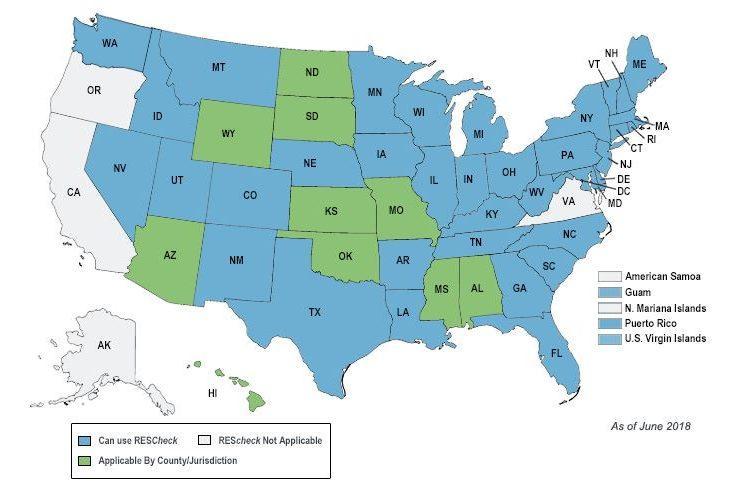
Contractors ask when is a RESCheck required more than almost any other permit question. The answer: when your jurisdiction enforces an IECC-based residential energy code and the building is a one- or two-family home or a multifamily building three stories or less above grade.
RESCheck is the U.S. Department of Energy’s software for residential compliance. The DOE explanation of RESCheck and COMcheck describes it as the tool for single-family homes and low-rise multifamily projects. Building departments commonly ask for it on:
- New single-family homes and townhomes
- Duplexes and low-rise apartment buildings
- Additions that add conditioned floor area
- Alterations that replace windows, insulation or other envelope assemblies
RESCheck covers the envelope trade-offs. It does not replace the Manual J, which still sizes the equipment. Florida is the notable exception to the RESCheck path, because it documents residential compliance on its own forms under the Florida Energy Code.
RESCheck proves the house meets the energy code; Manual J proves the equipment fits the house.
When Is COMCheck Required?

The short answer to when is COMCheck required: on commercial buildings and on residential buildings four stories or taller, wherever the jurisdiction enforces the commercial provisions of the IECC or ASHRAE 90.1. The DOE describes COMCheck as the compliance path for new commercial and high-rise residential buildings, additions and alterations.
For HVAC contractors, the mechanical section is usually what the plan reviewer reads first. It lists the equipment, efficiencies and controls, so it has to match the mechanical drawings exactly.
Typical projects that trigger a COMCheck include:
- Offices, retail stores, restaurants and medical clinics
- Schools, colleges and hospitals
- Apartment complexes four stories or taller, plus their common areas
- Tenant improvements and rooftop unit replacements in commercial spaces
Pair the COMCheck with a Manual N load calculation and a Manual Q or commercial duct design so every number in the package agrees.
On commercial work, the COMCheck and the mechanical plans have to tell the same story.
COMMERCIAL PERMIT ON YOUR DESK?
What Does a Permit-Ready Report Package Cost?
These three reports cover the load and energy side of most permits. Order them together and the numbers stay consistent.
Manual J
Residential load calculation
From $109
- Room-by-room heating and cooling loads
- Local design temperatures for your job site
- ACCA-approved software
RESCheck
Residential energy compliance
From $199
- Envelope trade-off calculations
- Matched to your state energy code
- Up to 2 minor revisions
COMCheck
Commercial energy compliance
From $299
- Commercial compliance documentation
- IECC or ASHRAE 90.1 path
- Ready for plan review

How Do Multi-State Contractors Keep Permits Moving?
Contractors who work across state lines lose the most time to resubmittals, not to the calculations themselves. A simple routine prevents most of them:
- Confirm the code edition for the exact job site address, not just the state.
- Download the local permit checklist and note which calculations are due at submittal.
- Decide the building classification early, residential or commercial, since it sets RESCheck versus COMCheck.
- Send complete plans with dimensions, window specs, insulation values and equipment model numbers.
- Order matched reports from one team so the Manual J, Manual S, Manual D and energy report agree.
- Answer reviewer comments fast with revisions included in the original order.
ACDuctDesign.com handles that routine for contractors in all 50 states. Standard delivery is 48 hours from receipt of all required information, with up to 2 minor revisions included. When the inspector is already scheduled, a 24-hour rush, meaning one business day, is available for an additional fee. Call 800-810-3280 to confirm availability.
Get the classification and code edition right on day one and the permit takes care of itself.
Frequently Asked Questions
What are the Manual J requirements for an HVAC permit?
When is a RESCheck required?
A RESCheck is typically required when a jurisdiction enforces an IECC-based residential energy code and the project is a one- or two-family home or a multifamily building three stories or less above grade, including many additions and envelope alterations.
When is COMCheck required?
A COMCheck is typically required for commercial buildings and residential buildings four stories or taller where the commercial provisions of the IECC or ASHRAE 90.1 apply, including many additions, alterations and equipment replacements.
Does Florida accept RESCheck?
Florida enforces its own Florida Building Code, Energy Conservation, and documents residential compliance on Florida-specific forms. Florida Energy Code compliance is prepared separately from a standard RESCheck.
How fast can I get permit reports?
Standard turnaround is 48 hours from receipt of all required information. A 24-hour rush, meaning one business day, is available for an additional fee; call 800-810-3280.
Can one company prepare reports for permits in different states?
Yes. ACDuctDesign.com prepares Manual J, D, S, N and Q calculations plus RESCheck and COMCheck reports for HVAC and general contractors in all 50 states, matched to the code edition at each job site.


0 comments
Write a comment